There is something wonderfully confusing about ordering a Manhattan or an Old Fashioned for the first time. Both are dark, elegant whiskey cocktails. Both use bitters. Both have roots in classic American bartending. And both look like the kind of drink you might order when you want something timeless rather than trendy.
But take one sip of each, and the difference becomes clear.
The Manhattan is richer, more aromatic, and more layered, thanks largely to sweet vermouth. The Old Fashioned is simpler and more whiskey-focused, with sugar and bitters supporting the spirit instead of adding another major flavor source. Neither drink is “better.” They simply suit different tastes, moods, and occasions.
If you are standing at a bar wondering which one to order, this guide will make the decision much easier. We will compare their ingredients, flavor, strength, preparation, glassware, history, calories, whiskey choices, and the situations where each drink makes the most sense.
What is the main difference between a Manhattan and an Old Fashioned?
The biggest difference is the sweetening ingredient.
A classic Old Fashioned combines whiskey with sugar, water, and bitters. A Manhattan combines whiskey with sweet vermouth and bitters. That one substitution changes almost everything about the drink’s personality.
Think of the Old Fashioned as a spotlight pointed directly at the whiskey. Sugar softens the edges, bitters add spice and depth, and dilution from ice brings the drink into balance.
The Manhattan is more like a small orchestra. Whiskey remains important, but sweet vermouth contributes herbal, fruity, spicy, and wine-like notes. Bitters tie those flavors together.
Here is the simplest comparison:
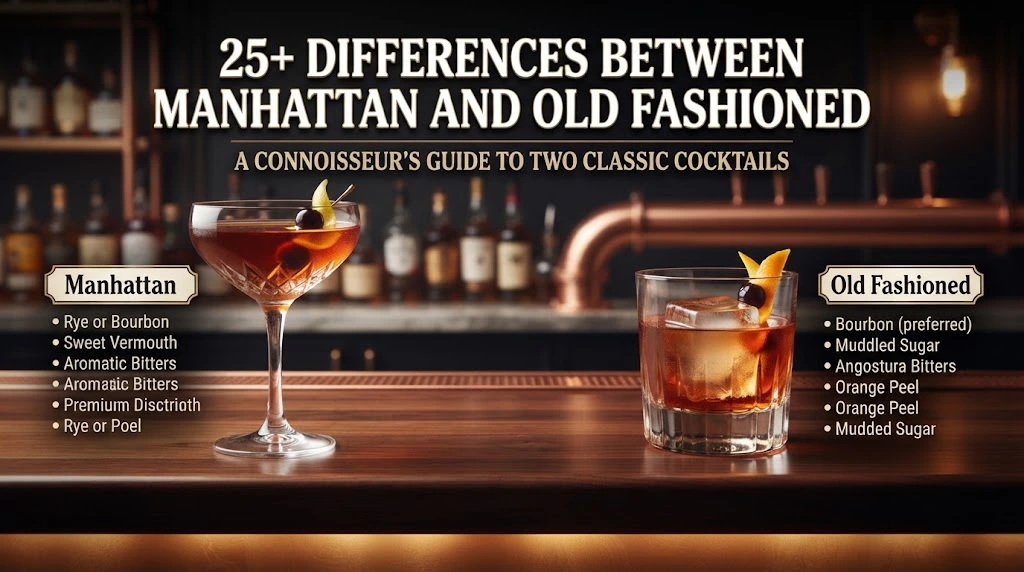
- Old Fashioned: whiskey + sugar + bitters + water/dilution
- Manhattan: whiskey + sweet vermouth + bitters
- Old Fashioned glass: usually a rocks glass
- Manhattan glass: usually a coupe or cocktail glass
- Old Fashioned garnish: commonly an orange twist
- Manhattan garnish: commonly a cocktail cherry
- Old Fashioned character: bold, simple, whiskey-forward
- Manhattan character: rich, aromatic, complex
Both are normally stirred rather than shaken. The difference is not about one being “strong” and the other being “weak.” It is about how each cocktail builds flavor around whiskey.
Manhattan vs Old Fashioned ingredients
The ingredient lists look short, but classic cocktails are unforgiving. When a drink contains only three or four main ingredients, every ingredient matters.
A standard Manhattan uses rye whiskey, sweet red vermouth, and Angostura bitters. The International Bartenders Association lists 50 ml of rye whiskey, 20 ml of sweet red vermouth, and one dash of Angostura bitters in its official recipe.
An Old Fashioned traditionally uses whiskey, sugar, bitters, and a small amount of water or dilution. Modern versions commonly use simple syrup instead of a sugar cube because it mixes more evenly.
The important distinction is that vermouth is not simply a liquid form of sugar. It is a fortified, aromatized wine with its own botanical character. That means it changes the flavor of the Manhattan in a way that sugar does not change the Old Fashioned.
For a home bar, you can think about the two recipes this way:
Old Fashioned
- 2 oz bourbon or rye
- Sugar or simple syrup
- Angostura bitters
- Ice
- Orange peel
Manhattan
- 2 oz rye or bourbon
- About 1 oz sweet vermouth, depending on the recipe
- Angostura bitters
- Ice
- Cocktail cherry or citrus peel
Recipes vary between bars and cocktail books, so you will see different ratios. The important thing is understanding the structure rather than treating one measurement as the only legitimate version.
Which cocktail tastes sweeter: Manhattan or Old Fashioned?
This question sounds simple, but the answer depends on the recipe.
An Old Fashioned often tastes sweeter in a direct, clean way because its sweetness comes from sugar or syrup. The whiskey remains obvious, but the sugar rounds out its sharper edges.
A Manhattan gets sweetness from sweet vermouth. Because vermouth also contains herbs, spices, fruit-like notes, and bitterness, its sweetness feels more integrated into a larger flavor profile. Some Manhattans may actually seem less sweet than an Old Fashioned even when both contain a noticeable amount of sugar.
That distinction matters when choosing your drink.
If you like:
- Caramel and vanilla → try a bourbon Old Fashioned.
- Baking spice and pepper → try a rye Old Fashioned.
- Herbal and wine-like flavors → try a Manhattan.
- A cleaner whiskey profile → try an Old Fashioned.
- A more layered cocktail → try a Manhattan.
One practical tip: do not judge sweetness only by sugar content. Aroma, bitterness, alcohol, acidity, dilution, and the whiskey itself all affect how sweet a drink seems.
Is a Manhattan stronger than an Old Fashioned?
Both cocktails can be fairly spirit-forward, so neither should be treated like a light mixed drink.
A Manhattan contains whiskey plus sweet vermouth, while an Old Fashioned contains whiskey with sugar and bitters. The vermouth adds volume and lowers the overall alcohol concentration compared with drinking the same amount of whiskey neat, although the exact strength depends on the recipe and dilution.
The IBA’s Manhattan specification uses 50 ml whiskey and 20 ml vermouth.
An Old Fashioned can feel especially powerful because the whiskey remains so prominent. There is no large mixer, juice, soda, or tonic to stretch it out.
This creates an interesting drinking experience:
Old Fashioned: often feels more directly boozy and whiskey-heavy.
Manhattan: can feel smoother and more rounded because vermouth adds body and flavor.
However, neither description means one universally has more alcohol. The actual alcohol content depends on the whiskey’s proof, recipe proportions, vermouth amount, ice dilution, and serving size.
If you are drinking at home, measure rather than guessing. A classic cocktail can look small while containing a substantial amount of spirits.
Manhattan vs Old Fashioned: bourbon or rye?
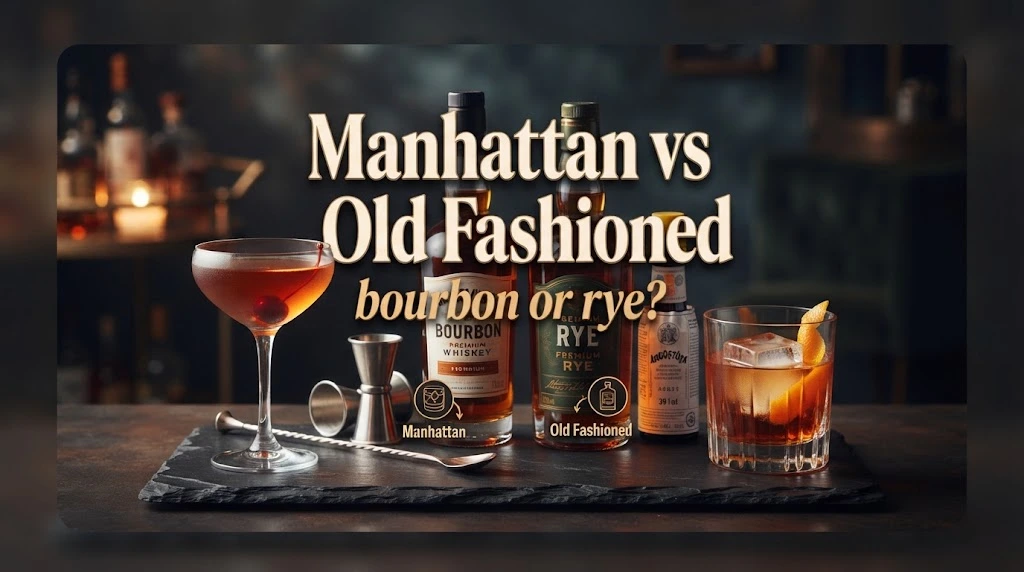
Both bourbon and rye can work in either cocktail, but they create noticeably different results.
Bourbon tends to bring sweeter flavors such as vanilla, caramel, oak, and baking spice. It usually makes an Old Fashioned feel rounder and softer.
Rye whiskey tends to bring more pepper, spice, dryness, and grain character. It gives a Manhattan a sharper backbone that works particularly well with sweet vermouth.
Traditionally, rye is strongly associated with the Manhattan, while bourbon has become a very common choice for the Old Fashioned. Still, there is no rule saying you cannot reverse them.
For beginners, I would make the choice based on the experience you want:
- Smooth and slightly sweet: bourbon
- Spicy and lively: rye
- Classic Manhattan style: rye + sweet vermouth
- Rich Old Fashioned: bourbon + sugar + bitters
- More assertive Old Fashioned: rye + sugar + bitters
A useful trick is to avoid using your most expensive whiskey in your first experiment. Start with a well-made, mid-range bottle. Once you understand the cocktail, you can decide whether a premium whiskey actually improves it for your palate.
Why does a Manhattan use sweet vermouth?
Sweet vermouth is what gives a Manhattan much of its personality.
Unlike sugar, vermouth contributes flavor as well as sweetness. It can bring herbal, floral, bitter, fruity, spice, and wine-like notes to the cocktail.
That is why replacing vermouth with simple syrup does not create a Manhattan. You would essentially be moving toward an Old Fashioned-style structure.
This is also why vermouth quality matters so much. In a cocktail containing several strong ingredients, people sometimes assume the whiskey is the only component worth buying carefully. That is a mistake.
A bottle of sweet vermouth can transform the drink.
One practical home-bar rule is especially important: store opened vermouth in the refrigerator and pay attention to its freshness. Unlike distilled whiskey, vermouth is a wine-based product and does not stay unchanged indefinitely after opening. Bon Appétit specifically recommends refrigeration and replacing an older opened bottle when appropriate.
If your Manhattan suddenly tastes flat, overly sweet, or strangely stale, the whiskey may not be the problem. Check the vermouth first.
Why is an Old Fashioned simpler than a Manhattan?
The Old Fashioned follows an older and remarkably simple cocktail formula: spirit, sugar, water, and bitters.
That simplicity is not a weakness. It is the reason the drink has survived for so long.
The classic concept goes back to the early definition of a cocktail as a mixture involving spirits, sugar, water, and bitters. The phrase “old-fashioned” later became associated with people asking for cocktails prepared in this older style.
In practical terms, the recipe gives the whiskey nowhere to hide.
If you use a harsh whiskey, you may notice it immediately. If you use a beautifully balanced bourbon or rye, you notice that too.
This makes the Old Fashioned a useful drink for learning about whiskey. Change the bourbon and keep everything else the same. Then change the bitters. Then alter the sugar slightly. Small changes become surprisingly obvious.
The Manhattan is also sensitive to ingredient quality, but its vermouth adds another major flavor layer. The Old Fashioned lets the base spirit speak more clearly.
Manhattan vs Old Fashioned preparation method
Both cocktails are generally stirred, not shaken.
That distinction matters.
Shaking introduces more aeration and usually creates a colder, more diluted drink with a different texture. Stirring is gentler and suits cocktails made entirely from clear or spirit-based ingredients.
For a Manhattan, combine the whiskey, sweet vermouth, and bitters with ice in a mixing glass. Stir until properly chilled and diluted, then strain into the serving glass. The IBA follows this basic approach.
For an Old Fashioned, the preparation can vary. You can build it directly in the rocks glass or mix it separately and then serve it over fresh ice.
For a reliable home version, try this approach:
- Add sugar syrup and bitters to the glass.
- Add whiskey.
- Add ice.
- Stir thoroughly.
- Add a large fresh cube if desired.
- Express an orange peel over the surface.
- Rub the peel around the rim and place it in the glass.
The most common mistake is under-stirring. Ice does more than make a cocktail cold. It also adds controlled dilution, which helps integrate the alcohol and flavors.
What glass should you use for each cocktail?
Glassware creates a surprisingly different experience.
A Manhattan is traditionally served up, meaning it is chilled and strained without ice in the serving glass. A coupe, Nick & Nora, or classic cocktail glass works well.
An Old Fashioned is normally served on the rocks, usually in a short rocks or Old Fashioned glass.
That difference affects more than appearance.
A Manhattan in a chilled stemmed glass feels polished and elegant. The aroma rises directly toward your nose, and every sip arrives at roughly the same temperature.
An Old Fashioned in a heavy rocks glass feels slower and more relaxed. A large cube gradually melts, adding dilution as you drink.
If you are hosting dinner, this gives you an easy styling rule:
- Manhattan: coupe or Nick & Nora, cherry garnish
- Old Fashioned: lowball or rocks glass, large cube, orange expression
The visual contrast is part of the charm. One feels like a dressed-up evening cocktail; the other feels like a quiet drink beside a fireplace.
Manhattan vs Old Fashioned garnish
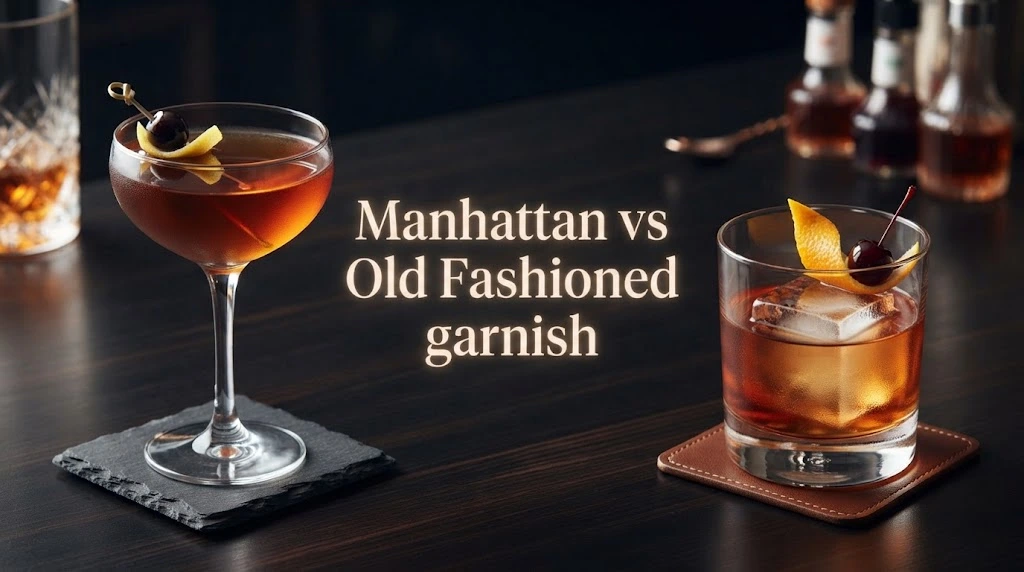
Garnishes are not just decoration.
A classic Manhattan is commonly finished with a cocktail cherry, although an orange or lemon peel can also work depending on the recipe. The IBA specifies a cocktail cherry.
The Old Fashioned is strongly associated with an orange twist.
The orange peel matters because its oils add aroma before the drink even reaches your tongue. To use one properly, hold the peel over the surface of the cocktail and give it a firm twist to release the citrus oils.
Avoid drowning the drink in fruit unless you intentionally want a sweeter, fruitier variation.
A styling note for home entertaining: use a fresh, wide strip of citrus peel rather than a thin, dried-looking sliver. It instantly makes the cocktail look more polished.
For a Manhattan, choose a quality cocktail cherry rather than the bright red supermarket cherries designed primarily for desserts. A good cherry adds a rich final note without making the cocktail taste like syrup.
Which is better for beginners?
If you are new to whiskey, the Old Fashioned is often the easier place to start.
Its structure is straightforward, and you can clearly taste what the whiskey is doing. If you find it too strong, you can adjust the dilution, sweetness, or whiskey choice without introducing another major flavor category.
The Manhattan is a better starting point if you already enjoy vermouth, wine, herbal flavors, or complex cocktails.
Here is a simple personality test:
Choose an Old Fashioned if you usually order:
- Bourbon neat
- Whiskey on the rocks
- Strong, spirit-forward drinks
- Drinks with citrus aroma
- Less complicated cocktails
Choose a Manhattan if you usually enjoy:
- Martinis
- Vermouth-based drinks
- Herbal flavors
- Rich, spiced cocktails
- Cocktails served up in a coupe
There is also a good learning exercise: make both drinks on the same evening using the same rye whiskey. Keep the bitters consistent. The sweetener is the major variable.
You will immediately understand why two cocktails with such similar foundations can taste so different.
Which cocktail is more sophisticated?
There is no objective winner here.
“Fancy” is mostly about context, presentation, and personal taste rather than a measurable quality.
The Manhattan has a naturally formal appearance. A chilled coupe, deep amber-red color, and elegant cherry make it look at home at a cocktail bar or dinner party.
The Old Fashioned has a quieter kind of sophistication. A large clear ice cube, good whiskey, and carefully expressed orange peel can look incredibly refined without trying too hard.
If I were styling drinks for an evening event, I would match the cocktail to the mood.
For a black-tie or dressy dinner, the Manhattan fits beautifully. For a relaxed whiskey tasting, leather-jacket evening, or intimate nightcap, the Old Fashioned feels more natural.
The best drink is the one that matches the moment.
Manhattan vs Old Fashioned for food pairing
Both cocktails can work with food, but their flavor profiles suggest different pairings.
The Old Fashioned’s whiskey-forward character works particularly well with rich, savory foods. Think grilled meat, roasted dishes, smoked flavors, aged cheese, or dark chocolate.
The Manhattan’s vermouth and bitters give it more aromatic complexity. That makes it interesting alongside richer appetizers, cured meats, mushroom dishes, roasted nuts, and desserts that are not overly sweet.
Be careful with very sugary desserts. A sweet cocktail next to an extremely sweet dessert can make both seem heavy.
For a dinner party, consider the progression:
Before dinner: Manhattan for a more aromatic aperitif-style experience.
After dinner: Old Fashioned as a slow, whiskey-centered nightcap.
That is not a hard rule, but it is a useful starting point.
Common mistakes when making a Manhattan
The Manhattan has only a few ingredients, so technique becomes important.
One of the biggest mistakes is using stale vermouth. Because vermouth is wine-based, it changes after opening. Keep it refrigerated and replace it when its flavor has noticeably deteriorated.
Another mistake is using too many bitters. Bitters are powerful. More does not automatically mean better.
Watch out for these problems:
- Using flat or old vermouth
- Making the cocktail too sweet
- Adding too much bitters
- Shaking instead of stirring
- Failing to chill the drink properly
- Using poor-quality ice
- Serving it without enough dilution
- Treating every Manhattan recipe as identical
Ratio matters too. Many recipes use something close to a 2:1 whiskey-to-vermouth relationship, but exact proportions vary. The IBA’s official recipe uses a somewhat lower vermouth proportion.
If your first Manhattan tastes too sweet, do not immediately blame the whiskey. Try less vermouth or a drier, more bitter style.
Common mistakes when making an Old Fashioned
The Old Fashioned looks almost impossible to get wrong. It is not.
The most common mistake is using too much sugar.
Sugar should support the whiskey, not turn the cocktail into a dessert. Start conservatively and adjust.
Another issue is poor dilution. A drink made with whiskey, bitters, and sugar can taste harsh if it does not receive enough water from stirring.
Avoid aggressively muddling large pieces of orange and cherry into the drink unless you specifically want that style. Modern classic versions generally focus on whiskey, sugar, bitters, and aromatic citrus rather than turning the glass into a fruit salad.
Other mistakes include:
- Using warm or poor-quality ice
- Adding excessive soda water without intending a variation
- Over-sweetening
- Using an extremely delicate whiskey that gets buried
- Skipping the orange aroma
- Stirring too little
- Using a tiny, rapidly melting ice cube when you want slow dilution
A large cube is particularly useful because it melts more slowly and lets you control dilution over time.
Manhattan or Old Fashioned: which should you order?
If you are standing at a bar and cannot decide, ask yourself one question:
Do I want the whiskey to be the whole story, or part of a bigger story?
If you want whiskey to dominate, order an Old Fashioned.
If you want whiskey blended with sweet vermouth, spice, herbs, and richer aromatics, order a Manhattan.
Here is a quick decision guide:
If you want…ChooseWhiskey-forward flavorOld FashionedMore herbal complexityManhattanBourbon and orangeOld FashionedRye and sweet vermouthManhattanA rocks glassOld FashionedA coupe or cocktail glassManhattanA slow sipperOld FashionedA polished dinner-party cocktailManhattanSimple ingredientsOld FashionedLayered flavorManhattanOrange aromaOld FashionedCocktail cherryManhattan
There is no wrong answer.
In fact, if you like whiskey, learning both is one of the best ways to understand classic cocktail structure. The drinks are similar enough to compare directly but different enough to teach you something new.
Manhattan vs Old Fashioned history
Both cocktails belong to the great American cocktail tradition of the 19th century, but their histories are not identical.
The Old Fashioned is closely connected to the earliest definition of a cocktail: spirit, sugar, water, and bitters. As bartending became more elaborate in the late 19th century, some drinkers began asking for cocktails made in the older style. The term “old-fashioned” eventually became attached to the drink.
The Manhattan emerged later, generally in the 1870s or 1880s, and introduced sweet vermouth into the whiskey-and-bitters framework. The Oxford Companion to Spirits & Cocktails describes this as an important development in the evolution of modern cocktails.
You may have heard a famous story claiming that the Manhattan was created for a party at the Manhattan Club hosted by Lady Randolph Churchill. That story is widely repeated, but historical evidence has challenged the tale, so it is better treated as cocktail folklore rather than settled fact.
The interesting part is not which legendary bartender supposedly invented it. It is how both drinks survived changing fashions and remain central to classic cocktail culture today.
Which cocktail is healthier or lower in calories?
Neither cocktail should be considered a “health drink.”
Both contain alcohol, and the calorie count depends on the amount and proof of whiskey, the amount of vermouth or sugar, and the exact recipe.
The Old Fashioned can contain relatively little added volume because its main ingredients are whiskey, sugar, and bitters. A Manhattan contains sweet vermouth, which adds additional calories from its wine and sugar content.
However, it would be misleading to declare one universally “low calorie.” Recipes and serving sizes vary too much.
If calorie awareness matters to you, focus on portion size and recipe balance rather than assuming the name of the cocktail tells you everything.
Also remember that alcohol itself contributes significant calories. Reducing unnecessary syrups, oversized pours, and sweet additions can help, but the drink remains an alcoholic beverage.
For anyone avoiding alcohol for health, medication, pregnancy, recovery, or other personal reasons, the best choice is an alcohol-free alternative rather than trying to make a classic whiskey cocktail fit that situation.
How to make a better Manhattan and Old Fashioned at home
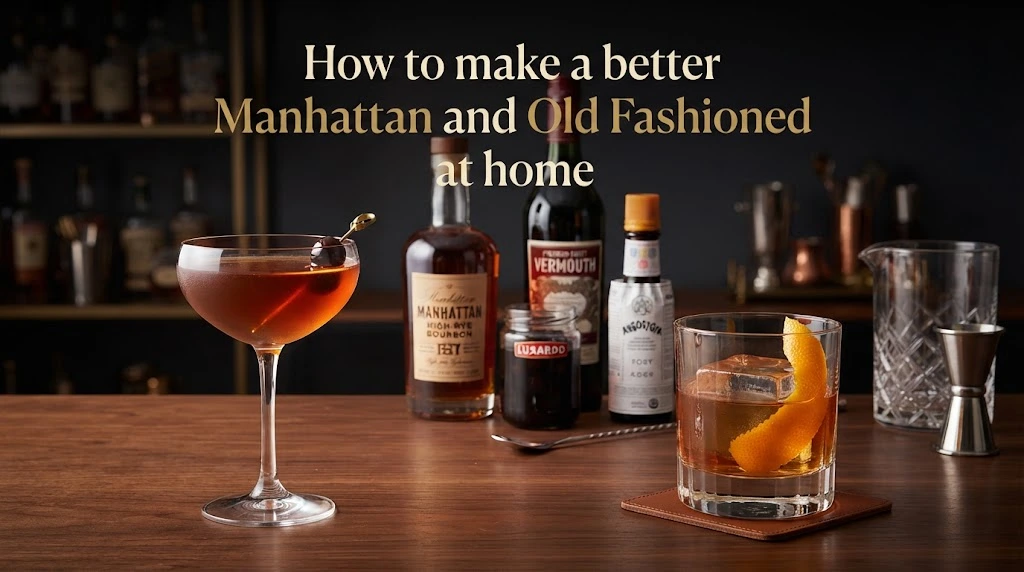
You do not need a professional bar setup.
A few basics will take you surprisingly far:
- A good mixing glass
- A long bar spoon
- A jigger
- A fine strainer
- Large, clean ice
- A rocks glass
- A coupe or Nick & Nora glass
- Fresh citrus
- Good bitters
- Fresh sweet vermouth
- A reliable bourbon or rye
For the Manhattan, start with rye if you want a classic spicy backbone. Use a quality sweet vermouth, stir with plenty of ice, and strain into a properly chilled glass. The IBA uses rye, sweet red vermouth, and Angostura bitters as its standard combination.
For the Old Fashioned, start with a bourbon if you prefer a softer, rounder drink. Add a modest amount of sugar syrup and bitters, then stir with ice until cold and properly diluted. Finish with a fresh orange expression.
Most importantly, taste and adjust.
If the Manhattan feels too sweet, reduce the vermouth slightly or choose a less sweet vermouth. If the Old Fashioned tastes too hot, give it more stirring time or use a little more dilution.
Classic cocktails are formulas, not laws carved into stone.
The best version is the one that remains balanced while matching your taste.
Conclusion
The difference between a Manhattan and an Old Fashioned comes down to one fundamental idea: what you use to balance the whiskey.
The Old Fashioned uses sugar and bitters, keeping the whiskey at center stage. The Manhattan uses sweet vermouth and bitters, creating a deeper, more aromatic cocktail with an extra layer of herbal and wine-like flavor. Both can use bourbon or rye, both are usually stirred, and both have earned their place among America’s great classic cocktails.
Choose the Old Fashioned when you want something direct, bold, and whiskey-driven. Choose the Manhattan when you want something richer, more complex, and slightly more dressed up.
And if you still cannot decide, order both on different nights.
That is not indecision. It is research.
FAQs
Is a Manhattan sweeter than an Old Fashioned?
Not necessarily. An Old Fashioned often has a more obvious sugar sweetness, while a Manhattan gets its sweetness from sweet vermouth, which also contributes herbal, bitter, fruity, and spicy flavors. The exact sweetness depends on the recipe and ingredients.
Can you make a Manhattan with bourbon?
Absolutely. Rye is the traditional and widely recognized choice, but bourbon works very well. Bourbon usually makes the cocktail rounder and sweeter, while rye gives it a spicier, drier character.
Can you make an Old Fashioned with rye?
Yes. Bourbon and rye both work in an Old Fashioned. Rye creates a spicier, more assertive drink, while bourbon usually produces a softer and sweeter profile.
Which is stronger, a Manhattan or an Old Fashioned?
It depends on the recipe, whiskey proof, serving size, and dilution. Both are spirit-forward cocktails. A Manhattan contains vermouth, while an Old Fashioned relies more heavily on whiskey, so an Old Fashioned can often feel more directly boozy.
Why is a Manhattan served in a cocktail glass?
A Manhattan is traditionally stirred with ice and then strained into a chilled stemmed cocktail glass, coupe, or similar glass. This presents the drink without serving ice in the final glass and gives it its classic elegant appearance.
Why is an Old Fashioned served over ice?
The Old Fashioned is traditionally served in a rocks glass over ice. A large cube is especially useful because it chills the drink while melting relatively slowly, allowing controlled dilution as you sip.
Which should I choose if I am new to whiskey cocktails?
Start with an Old Fashioned if you want to understand the flavor of whiskey more directly. Choose a Manhattan if you already enjoy herbal, wine-like, or more layered cocktails. Once you have tried both, your personal preference will become much easier to identify.