
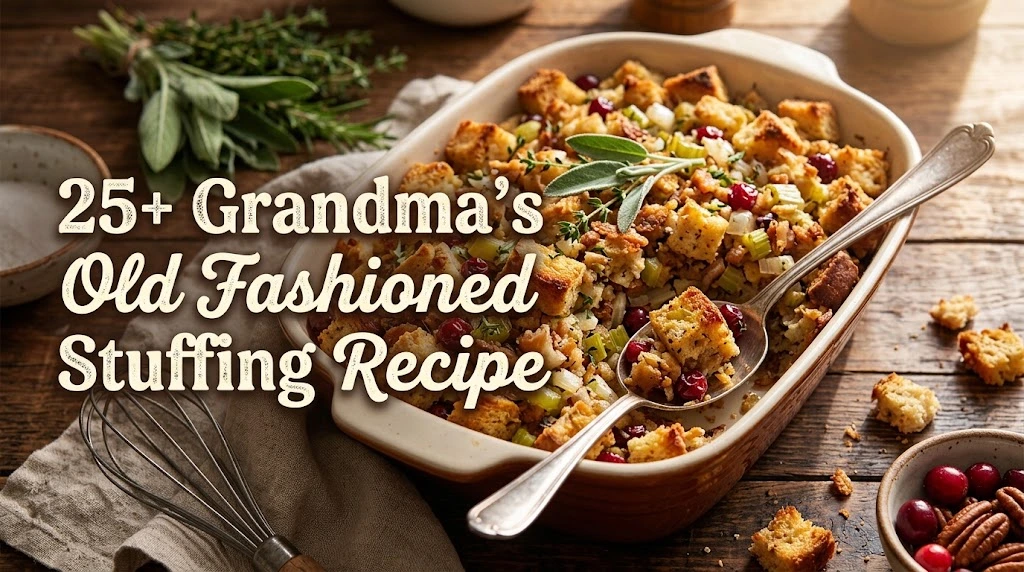
There are some recipes that do more than fill a plate. They bring back a kitchen, a holiday table, and the feeling of watching someone you love cook without ever measuring a thing. Old-fashioned stuffing is one of those recipes. It is humble food, built from day-old bread, butter, onion, celery, herbs, and broth, yet the smell alone can make Thanksgiving feel like home.
The best part is that you do not need fancy ingredients or complicated techniques. A good homemade stuffing depends on a few simple details: dry bread, flavorful vegetables, enough seasoning, and just the right amount of broth. Get those right, and you will have stuffing that is moist and tender inside with golden, slightly crisp edges.
This version keeps the traditional character people expect from a family-style stuffing while adding clear measurements and practical tips. It works beautifully alongside turkey, roast chicken, gravy, mashed potatoes, cranberry sauce, or a simple Sunday roast.
What Makes Traditional Homemade Stuffing So Special?
Traditional stuffing stands apart because it does not try to be complicated. Its flavor comes from familiar ingredients that work together rather than from a long list of extras.
The foundation is usually bread, preferably bread that has dried for a day or two. Dry bread absorbs seasoned broth without immediately turning into paste. Butter adds richness, while onion and celery create the savory base that gives classic stuffing its recognizable flavor.
Fresh or dried herbs also matter. Sage is the traditional star, but thyme, parsley, rosemary, or a small amount of poultry seasoning can round out the flavor.
Another reason old-fashioned stuffing tastes so comforting is texture. You want some pieces to become soft and flavorful while other pieces keep enough structure to give you something to bite into.
A good batch should be:
- Moist but not soggy
- Savory without being overly salty
- Soft in the center
- Lightly crisp around the edges
- Fragrant with herbs and butter
- Firm enough to scoop and serve neatly
That balance is what makes homemade stuffing so much better than a bland, overly wet version.
The Best Bread for Classic Stuffing
Bread is the most important ingredient because it controls the final texture. You can use several types, but plain white sandwich bread gives the most nostalgic, traditional result.
A sturdy French bread, Italian bread, sourdough, or country loaf also works well. Avoid bread that is extremely soft and fresh because it tends to absorb broth too quickly.
If you have time, cut the bread into roughly ¾-inch cubes and spread them over baking sheets. Leave them uncovered overnight. This method gives you naturally stale bread without much effort.
For a faster method, bake the cubes at about 250°F until they feel dry rather than deeply browned. Stir them once or twice so they dry evenly.
Do not confuse dry bread with toasted bread. You are trying to remove moisture, not turn every cube into a crouton. Slightly golden edges are fine, but very dark bread can make the stuffing taste bitter.
For this recipe, aim for about 10 to 12 cups of dried bread cubes. That amount makes a generous side dish for a family holiday meal.
Ingredients You Need for Old-Fashioned Stuffing
You only need everyday ingredients, which is part of the charm.
For the stuffing:
- 10–12 cups dried bread cubes
- 8 tablespoons unsalted butter
- 1 large yellow onion, finely chopped
- 3 celery ribs, finely chopped
- 2 to 3 cloves garlic, minced
- 2 teaspoons dried sage, or 1 tablespoon finely chopped fresh sage
- 1 teaspoon dried thyme
- ½ teaspoon dried rosemary, crushed
- ¼ cup chopped fresh parsley
- 1 teaspoon salt, plus more if needed
- ½ teaspoon black pepper
- 2½ to 3½ cups low-sodium chicken or turkey broth
- 2 large eggs, lightly beaten
The eggs are optional in some family recipes, but they help the stuffing hold together and create a slightly richer, more cohesive texture.
If you prefer a very soft, spoonable stuffing, use a little more broth. If you love distinct bread pieces and crisp edges, stay toward the lower end of the broth range.
Low-sodium broth gives you more control over seasoning. This matters because bread, butter, broth, and poultry drippings can all contribute salt.
How to Make the Stuffing Step by Step
Start by preparing your bread. If it is not already dry, cube it and dry it in the oven until the surface feels firm and the center has lost most of its moisture.
Next, melt the butter in a large skillet over medium heat. Add the chopped onion and celery. Cook for about 7 to 10 minutes, stirring occasionally, until the vegetables become tender and the onion looks translucent.
Add the garlic, sage, thyme, rosemary, salt, and black pepper. Cook for another minute. You should smell the herbs immediately, but do not let the garlic or herbs burn.
Place the dried bread cubes in a large mixing bowl. Pour the warm butter and vegetable mixture over the bread and gently toss.
Warm the broth separately or use it at room temperature. Add it gradually rather than dumping it all in at once. Toss after each addition and stop when the bread feels moist but still holds its shape.
Let the mixture cool slightly. Then stir in the beaten eggs and fresh parsley.
Transfer everything to a buttered 9-by-13-inch baking dish. Spread it into an even layer without packing it down too tightly.
Cover with foil and bake at 375°F for about 25 to 30 minutes. Remove the foil and continue baking for another 15 to 20 minutes, until the top is golden and the edges are lightly crisp.
The exact baking time depends on the depth of your dish and how moist the mixture is. A shallow dish generally browns faster than a deep casserole.
How Much Broth Should You Add?

This is where many stuffing recipes go wrong. The amount of broth needed depends on how dry your bread is.
Very dry bread may need close to 3½ cups. Bread that has only dried overnight may need considerably less.
Instead of following the number blindly, use your hands. Pick up a small handful of the seasoned bread mixture and gently squeeze it. It should feel moist and hold together briefly, but it should not release a puddle of liquid.
If the bread feels dry and crunchy throughout, add more broth in small splashes.
If the mixture already feels heavy and wet, stop adding broth. You cannot easily rescue stuffing that has absorbed too much liquid.
A useful rule is add gradually and wait a few seconds between additions. Bread continues absorbing liquid as it sits, so patience gives you much better control.
If you accidentally add too much broth, add more dried bread cubes if you have them. You can also spread the mixture into a wider baking dish to encourage moisture to evaporate during baking.
Fresh Herbs vs. Dried Herbs: Which Is Better?
Both work, and each has a place in a traditional stuffing recipe.
Fresh sage gives a strong, earthy aroma that feels especially festive. Fresh parsley adds brightness and color. Fresh thyme is delicate and fragrant.
Dried herbs, however, are convenient and often more concentrated. They are particularly useful when you are cooking a large holiday meal and do not want to wash and chop several bunches of herbs.
For the most traditional flavor, sage deserves the most attention. Use it carefully because too much sage can make stuffing taste medicinal or overpowering.
A balanced herb mixture might include:
- Sage for the classic savory flavor
- Thyme for a gentle herbal note
- Parsley for freshness
- A small amount of rosemary for depth
Poultry seasoning can also be used, especially if that is the flavor you remember from childhood. Check its ingredient list first because many blends already contain sage, thyme, rosemary, and marjoram. You do not want to accidentally double the herbs.
How to Get Moist Stuffing With Crispy Edges
The ideal stuffing has a contrast between the soft center and browned surface. You can achieve that with a few simple choices.
First, use a wide baking dish rather than piling the stuffing into a very deep casserole. More surface area means more opportunity for the top and edges to brown.
Second, do not cover the dish for the entire baking time. Foil traps steam and helps the center stay moist, but removing it during the second part of baking allows the surface to dry and brown.
Third, lightly dot the top with a little extra butter before baking if you want a richer, more golden crust.
Finally, resist the urge to mash the bread mixture into the dish. A loosely packed mixture gives steam somewhere to move and helps preserve the texture of the bread.
If you like especially crisp stuffing, spread it in a slightly shallower dish. You can even place some of the mixture in a small separate baking dish so it gets extra browned edges.
Can You Make This Stuffing Ahead of Time?
Yes, and making it ahead can make a holiday meal much easier.
You can dry the bread several days in advance and store it in an airtight container once it has completely cooled. You can also chop the onion, celery, and herbs ahead of time.
For the assembled stuffing, prepare the mixture without baking it and refrigerate it in a covered baking dish. Because the recipe contains eggs and broth, keep it properly chilled and avoid leaving it at room temperature for extended periods.
When you are ready to bake, take the dish from the refrigerator while the oven preheats. If the dish is made of glass or ceramic, avoid exposing a very cold dish to sudden extreme heat because thermal shock can cause some cookware to crack.
You may need to add a few extra minutes to the baking time when starting with refrigerated stuffing. The center should become fully hot before serving.
For the best texture, I prefer preparing the bread and vegetable mixture ahead but doing the final broth adjustment and assembly closer to baking time.
Can You Freeze Homemade Stuffing?
Stuffing freezes well when handled properly, which makes it useful for busy holiday cooking.
For the best result, cool cooked stuffing promptly and store it in a freezer-safe, airtight container. Flattening it into a relatively shallow layer helps it freeze and thaw more evenly.
When reheating, make sure the center becomes thoroughly hot. Add a small splash of broth if the stuffing seems dry after thawing.
You can also freeze individual portions. This is especially handy when you have a large Thanksgiving dinner and plenty of leftovers.
Keep in mind that freezing can soften the texture slightly. The flavor usually remains excellent, but freshly baked stuffing will have the best crisp edges.
If crispness matters to you, reheat thawed stuffing uncovered in the oven rather than relying entirely on the microwave. The microwave is convenient, but it does not recreate that freshly browned surface.
Easy Variations on the Classic Recipe

The traditional version is excellent on its own, but you can make small changes without losing its old-fashioned character.
For a sausage stuffing, brown mild breakfast sausage separately and drain excess fat before mixing it with the bread and vegetables.
For a richer holiday version, replace part of the chicken broth with turkey broth or homemade stock. Turkey drippings can also add wonderful flavor, provided they are handled and stored safely.
Mushrooms are another good addition. Cook sliced mushrooms thoroughly with the onion and celery so they release their moisture before they go into the bread.
For a slightly sweet variation, add a small amount of dried cranberries or chopped apple. Keep the quantity modest so the dish still tastes like savory stuffing rather than fruit bread.
You can also experiment with different breads. Sourdough brings a mild tang, cornbread creates a softer and slightly sweet dressing, and a rustic country loaf gives you hearty, chewy pieces.
The important thing is to change one or two elements at a time. That makes it easier to understand what each ingredient contributes.
Stuffing vs. Dressing: What’s the Difference?
The words stuffing and dressing often describe the same basic bread-based side dish, but regional and family traditions influence which term people use.
Technically, stuffing is often associated with a bread mixture cooked inside poultry, while dressing is baked separately in a casserole dish. In everyday conversation, however, many cooks use the terms interchangeably.
For this recipe, baking the mixture separately is the simpler and more controllable approach.
It also makes food safety easier because you can monitor the cooking process without relying on the temperature of a stuffed turkey cavity. If you do decide to cook stuffing inside poultry, use a reliable food thermometer and follow established poultry food-safety guidance.
Baking the stuffing on its own also gives you more control over the texture. You can uncover it near the end and get those desirable golden edges without overcooking the turkey.
Common Stuffing Mistakes and How to Fix Them
Even an easy stuffing recipe can go sideways. Fortunately, most problems have simple causes.
Mistake: Using fresh, soft bread. Fresh bread can collapse under the broth. Dry the cubes first so they can absorb liquid while keeping their shape.
Mistake: Adding all the broth at once. This makes it difficult to judge moisture. Add broth gradually and toss between additions.
Mistake: Over-seasoning early. Broth varies in saltiness. Season the vegetables, then taste the mixture before adding more salt.
Mistake: Packing the casserole too tightly. A compressed mixture can become dense. Spread it gently into the baking dish.
Mistake: Covering it from start to finish. The stuffing may stay moist, but the top will not develop much color. Remove the foil toward the end.
Mistake: Burning the vegetables. High heat is unnecessary. Cook the onion and celery slowly until tender and fragrant.
Mistake: Using too much sage. Sage is powerful. Start with a moderate amount and add more only if you know you want a stronger flavor.
Mistake: Serving it immediately from the oven. Let the stuffing rest for several minutes. It will settle slightly and become easier to scoop.
How to Serve Old-Fashioned Stuffing
Stuffing naturally belongs beside roasted turkey, but it does not need to wait for Thanksgiving.
Serve it with roast chicken on a Sunday evening, alongside pork chops in the fall, or with a simple roasted vegetable dinner when you want something hearty.
A classic holiday plate might include:
- Roast turkey
- Homemade stuffing
- Mashed potatoes
- Turkey gravy
- Cranberry sauce
- Green beans
- Roasted carrots
- Warm dinner rolls
Gravy is especially good with stuffing because it adds moisture without changing the seasoning of the casserole itself.
For leftovers, spoon stuffing into a skillet with a little butter and warm it until the bottom becomes crisp. Top it with a fried egg for a surprisingly satisfying breakfast or lunch.
You can also use leftover stuffing as a filling for roasted vegetables or as a crispy topping for a turkey casserole.
How to Make This Recipe Taste Like Grandma Made It

The secret is not one magical ingredient. It is usually restraint and attention to texture.
Grandma-style cooking often starts with simple ingredients and gives them enough time to develop flavor. Do not rush the onion and celery. Let the butter become fragrant with the herbs. Dry the bread properly. Add the broth carefully.
Another useful trick is tasting before the eggs go in. Take a small spoonful of the seasoned bread mixture and check the salt and herbs. The flavor should be slightly stronger than you want the finished stuffing to taste because the bread will mellow it.
If you have homemade chicken or turkey stock, use it. A flavorful stock gives the stuffing more depth than plain water or very mild broth.
And do not worry about making every bread cube identical. Homemade stuffing should look homemade. A mixture of smaller and larger pieces creates interesting texture and makes the dish feel less processed.
Most importantly, cook it for the people at your table rather than chasing perfection. Some families love extra sage. Others want lots of crispy edges. Some want sausage, while others insist that vegetables are all the stuffing needs. Those preferences are part of what makes a family recipe worth keeping.
Frequently Asked Questions About Homemade Stuffing
Can I use fresh bread for stuffing?
Yes, but drying it first gives you better results. Fresh bread contains more moisture and can become mushy when you add broth. Cut it into cubes and dry it in the oven or leave it uncovered overnight.
Why did my stuffing turn out soggy?
The most common reason is too much broth or bread that was not dry enough. Add liquid gradually and stop as soon as the bread becomes moist but still retains its shape.
Should stuffing be covered while baking?
Cover it for the first part of baking to keep the center moist, then remove the foil so the top can brown. If you prefer very crisp stuffing, leave it uncovered for a larger portion of the cooking time.
Can I make stuffing without eggs?
Absolutely. Eggs help bind the mixture, but they are not essential. Egg-free stuffing will usually have a looser, more spoonable texture.
What herbs are best for traditional stuffing?
Sage is the classic choice, followed by thyme and parsley. Rosemary can add depth, but use it sparingly because its flavor is strong.
Can I prepare stuffing the night before Thanksgiving?
Yes. Dry the bread and prepare the vegetable mixture ahead of time. You can also assemble the stuffing and refrigerate it before baking, provided it is kept properly chilled and handled safely.
How do I reheat leftover stuffing without drying it out?
Add a small splash of broth, cover the dish, and reheat until thoroughly hot. For crisp edges, uncover it for the final few minutes in the oven.
Conclusion
The best traditional stuffing does not need expensive ingredients, unusual flavors, or complicated techniques. It needs good dry bread, plenty of savory vegetables, fragrant herbs, rich butter, flavorful broth, and careful attention to moisture.
Once you understand those basics, the recipe becomes wonderfully flexible. You can keep it simple for a quiet family dinner, add sausage for a holiday feast, or build your own version around the flavors your family loves.
That is really the beauty of an old-fashioned recipe. It gives you a dependable starting point while leaving room for memories and personal touches.
Make the bread dry, season thoughtfully, add the broth slowly, and give the stuffing enough time to brown. Then bring the casserole to the table while it is warm and fragrant.
You may find that the first bite tastes less like a side dish and more like a memory.