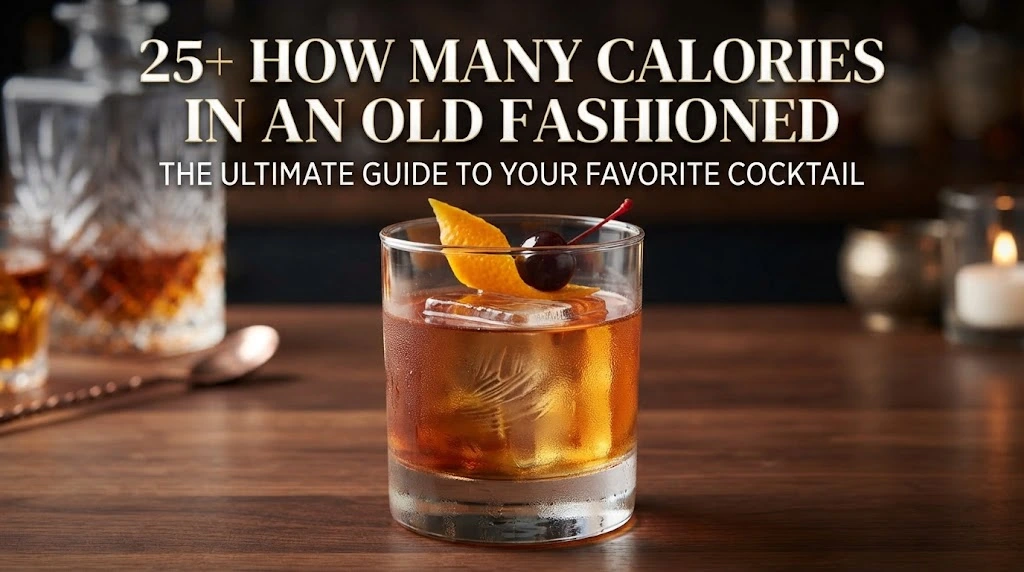
If you are watching your calories but still enjoy a good cocktail at the end of the week, the Old Fashioned can be a little confusing. It looks simple—whiskey, bitters, sugar, ice, and perhaps an orange peel—but the calorie count can change quite a bit depending on how the drink is made.
So, how many calories in an old fashioned? A classic Old Fashioned commonly lands around 150 to 200 calories per drink, although larger pours, extra sugar, and sweeter variations can push the number higher. Published recipes show just how much the answer can vary: one classic recipe lists 162 calories, while another lists 191 calories, and a bourbon-focused version lists 175 calories.
That difference does not mean one source is necessarily wrong. The calorie count depends mainly on the amount and proof of whiskey, the amount of sugar or syrup, and any additional ingredients.
This guide breaks down exactly where those calories come from, how bourbon compares with rye, whether bitters matter, how many calories are in common Old Fashioned variations, and how to order or make a lighter version without turning the cocktail into something completely different.
How Many Calories Are in a Classic Old Fashioned?
A traditional Old Fashioned usually contains about 150 to 200 calories. That is a practical range rather than one universal number because recipes use different whiskey measurements and sweeteners.
For example, VinePair lists a 2½-ounce bourbon or rye version with ½ ounce of simple syrup at 162 calories. Difford’s Guide lists its Old Fashioned at 192 calories, while its bourbon version comes in at 175 calories.
Another recipe from Good Food lists 191 calories for a drink made with 60 ml of whiskey, sugar or syrup, bitters, and optional soda water and fruit garnish.
That gives you a useful takeaway: a standard restaurant or home-poured Old Fashioned is often somewhere around 175–200 calories, but the actual number can be lower or higher.
The biggest factor is usually not the orange peel. It is the whiskey.
If your bartender pours a generous 2½ or 3 ounces instead of 2 ounces, you can add a meaningful number of calories before the sugar even enters the picture.
Where Do the Calories in an Old Fashioned Come From?
An Old Fashioned gets most of its calories from alcohol, with additional calories coming from sugar or simple syrup.
The classic cocktail is intentionally minimal. A traditional recipe uses whiskey, sugar, bitters, water, ice, and an orange garnish. Liquor.com, for example, uses 2 ounces of bourbon, 1 teaspoon of sugar, three dashes of bitters, and a teaspoon of water.
Here is the basic calorie picture:
- Whiskey: The main calorie source
- Sugar or simple syrup: Adds carbohydrate calories
- Bitters: Usually contribute only a small amount because the serving is tiny
- Orange peel: Adds very few calories when used only as a garnish
- Water and ice: No meaningful calories
This is why removing the cherry or orange garnish does not dramatically change the calorie count. Those ingredients are not where most of the energy comes from.
Likewise, adding more ice does not make the cocktail lower in calories. Ice can dilute the drink as it melts, but it does not remove the calories already present in the whiskey and sugar.
If you are tracking calories, measure the whiskey and sweetener first. Those two ingredients deserve far more attention than the garnish.
How Many Calories Are in the Whiskey?
Whiskey is responsible for most of the calories in an Old Fashioned because alcohol itself contains calories.
An important point is that the calorie count changes with both serving size and alcohol strength. A standard 1.5-ounce serving of 80-proof bourbon is about 97 calories, according to a dietitian-reviewed 2026 overview of bourbon nutrition. Higher-proof bourbon contains more calories per equivalent pour because it contains more alcohol.
That means a 2-ounce pour will contain more calories than a 1.5-ounce pour, and a 100-proof whiskey will generally contain more calories than an 80-proof whiskey when you compare the same volume.
This matters because Old Fashioneds are often poured generously at bars.
For example, if you normally make yours with 2 ounces of bourbon, you can estimate the whiskey portion at roughly 129 calories for an 80-proof spirit. A 2½-ounce pour would be higher.
The exact number depends on the whiskey’s proof and the nutrition data used.
This is one reason calorie estimates online sometimes disagree. One recipe might use 1½ ounces of whiskey, another 2 ounces, and another 2½ ounces.
When comparing two Old Fashioned recipes, check the whiskey measurement before comparing their total calories.
How Many Calories Does Sugar Add to an Old Fashioned?
Sugar is the second major calorie source in a classic Old Fashioned.
One teaspoon of granulated sugar contains roughly 16 calories. A teaspoon does not sound like much, but cocktail recipes sometimes use more than that, especially when they rely on simple syrup.
Liquor.com‘s classic recipe uses 1 teaspoon of sugar. Good Food uses either 2 teaspoons of sugar syrup or 1 teaspoon of granulated sugar.
Simple syrup deserves special attention because it contains both sugar and water. A half-ounce of simple syrup can contain considerably more sugar than a teaspoon of granulated sugar, depending on the syrup’s concentration.
That explains why two cocktails that look almost identical can have noticeably different calorie counts.
If you are making an Old Fashioned at home and want better calorie control, measure the sweetener rather than pouring it freely from a bottle.
A bar spoon or measured jigger can make a surprisingly big difference.
You can also gradually reduce the sugar. Because bitters and whiskey already provide plenty of flavor, you may discover that you enjoy a less-sweet Old Fashioned more than you expected.
Do Bitters Add Calories to an Old Fashioned?
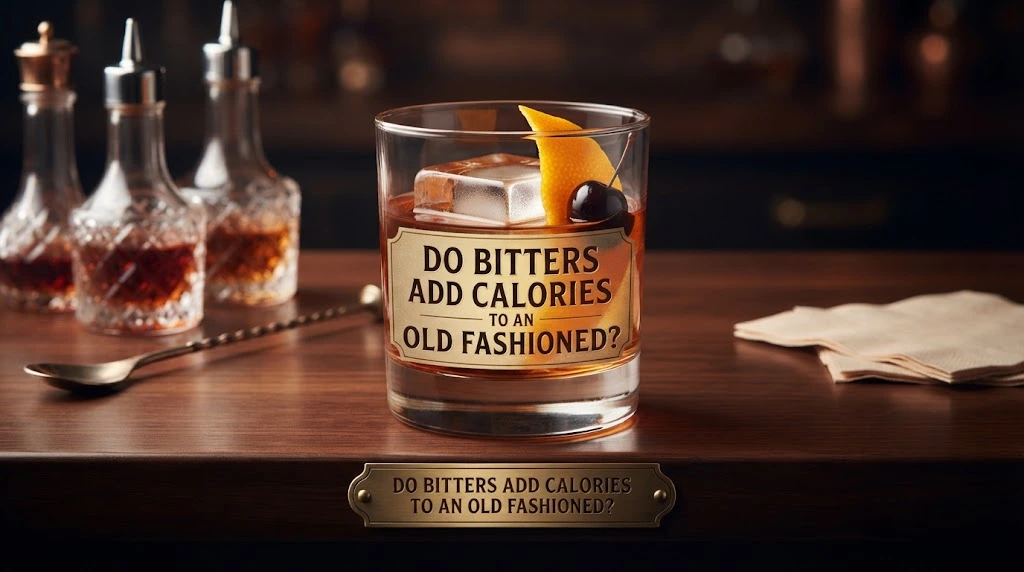
Yes, bitters can contain calories, but their contribution to the total is generally small compared with the whiskey and sugar.
An Old Fashioned typically uses only a few dashes of bitters. Liquor.com‘s recipe calls for three dashes of Angostura bitters.
Because the quantity is so small, bitters are not usually the ingredient you need to worry about when counting calories.
They are far more important for flavor.
Bitters add aromatic, spicy, herbal, and slightly bitter notes that help balance the sweetness of the cocktail. Without them, you essentially have sweetened whiskey rather than a properly balanced Old Fashioned.
This is a useful lesson for anyone trying to make a lighter cocktail: do not remove flavorful ingredients simply because they sound complicated.
Reducing unnecessary sugar or controlling the whiskey pour will usually have a much larger effect than eliminating a few dashes of bitters.
How Many Calories Are in a Bourbon Old Fashioned?
A bourbon Old Fashioned commonly contains roughly 170 to 200 calories, although recipes vary.
Difford’s Guide lists a bourbon Old Fashioned at 175 calories using 2 ounces of bourbon, a quarter-ounce of rich brown-sugar syrup, and three dashes of Angostura bitters.
A separate bourbon Old Fashioned recipe from Jennifer Cooks lists 172 calories for 2 ounces of bourbon, a demerara sugar cube, and orange bitters.
The difference between these estimates is small enough that you should not treat any single number as an exact laboratory measurement.
Brand, proof, serving size, syrup concentration, and recipe technique all matter.
If you are logging a homemade bourbon Old Fashioned, a reasonable starting estimate is around 175 calories for a modest 2-ounce pour with a restrained amount of sugar.
If you are at a cocktail bar, however, the pour may be larger. In that case, 200 calories or more can be a more realistic estimate.
The safest approach for accurate tracking is to ask about the whiskey pour and sweetener rather than relying on the drink’s name alone.
Are Rye and Bourbon Old Fashioneds Different in Calories?
Rye and bourbon are both whiskey, so their calorie counts are often fairly similar when you compare the same proof and serving size.
The larger issue is how much whiskey goes into the glass.
An Old Fashioned can be made with bourbon or rye. Liquor.com specifically notes bourbon as a common choice but also recommends rye as an option.
Bourbon tends to have a naturally round, slightly sweeter profile, while rye often brings more spice and a drier impression. Those flavor differences can affect how much sugar you feel you need.
That creates an interesting practical advantage for rye. If you enjoy its spicy character, you may be perfectly happy with less added sweetness.
However, do not assume that ordering rye automatically makes the cocktail lower in calories. A 2-ounce pour of rye is still an alcoholic spirit and contributes most of the drink’s calories.
For calorie purposes, proof and volume matter more than whether the label says bourbon or rye.
How Many Calories Are in a 2-Ounce Old Fashioned?
If your Old Fashioned contains 2 ounces of 80-proof whiskey, the spirit alone is roughly 129 calories.
You then add the sugar and small contribution from bitters. Depending on the recipe, that can put the finished cocktail somewhere around 145 to 175 calories.
One published recipe using 2 ounces of bourbon, ½ teaspoon sugar, bitters, and water lists 145 calories.
Another recipe using 2 ounces of bourbon and a demerara sugar cube lists 172 calories.
The spread shows why the phrase “one Old Fashioned” does not automatically tell you the calorie count.
A 2-ounce drink made with a small amount of sugar can be considerably lighter than a 2-ounce drink made with a generous serving of syrup.
If you are tracking your intake at home, the easiest method is to measure the whiskey and sweetener separately.
You do not need a complicated formula every time. Once you know the approximate calories in your preferred whiskey and usual sweetener, you can make a consistent estimate.
How Many Calories Are in a 1.5-Ounce Old Fashioned?
A 1.5-ounce Old Fashioned can be noticeably lower in calories because you are reducing the amount of whiskey, which is the main calorie source.
For reference, 1.5 ounces of 80-proof bourbon contains about 97 calories.
Once you add a small amount of sugar and bitters, a lighter Old Fashioned might land around 115 to 130 calories, depending on the exact recipe.
Difford’s Guide lists a no-sugar, low-calorie Old Fashioned using 1⅔ ounces of bourbon and a sugar-free sweetener at 124 calories.
However, reducing the whiskey changes more than the nutrition label. It also changes the character of the drink.
If you enjoy a strong, spirit-forward cocktail, a 1.5-ounce pour may taste lighter than the classic version.
One solution is to use a high-quality whiskey, a large ice cube, and plenty of aromatic bitters. You can still create a flavorful cocktail without simply adding more alcohol.
How Many Calories Are in a 3-Ounce Old Fashioned?
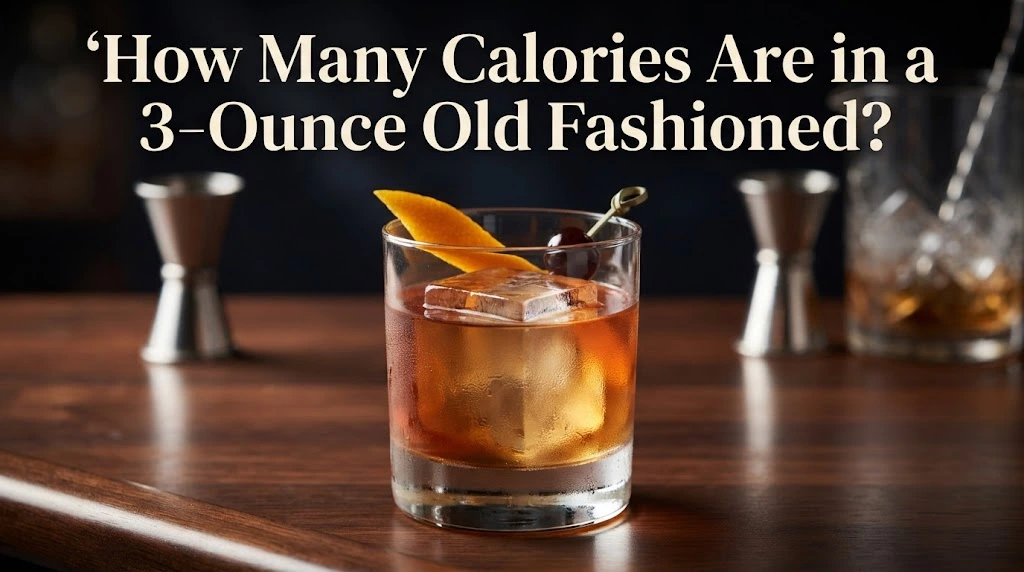
A 3-ounce Old Fashioned can easily exceed 200 calories, particularly when made with standard 80-proof whiskey and a normal amount of sugar.
The reason is straightforward: you are increasing the amount of the ingredient that supplies most of the calories.
For example, if 1.5 ounces of 80-proof bourbon provides about 97 calories, doubling that spirit amount roughly doubles the alcohol-derived calories.
Once you add sugar and bitters, a large-pour Old Fashioned can move toward the 200-plus range.
Some bar recipes also use more than 3 ounces or employ generous amounts of syrup. In those cases, the calorie count can climb substantially.
This is why a cocktail that looks like a single serving can sometimes contain much more alcohol than you expect.
If you are trying to manage calories, ask for a standard pour rather than a double. You can still enjoy the cocktail without accidentally turning one drink into a much larger serving.
How Many Calories Are in an Old Fashioned With Simple Syrup?
The calorie count depends heavily on how much simple syrup the bartender or recipe uses.
Simple syrup is typically made from sugar and water, so its calorie contribution comes almost entirely from the sugar.
A recipe using a small amount of syrup may stay within the typical 150–200 calorie range. A sweeter recipe with a larger syrup pour can go well beyond it.
Good Food’s Old Fashioned recipe uses 2 teaspoons of sugar syrup or 1 teaspoon of granulated sugar and lists the finished drink at 191 calories.
The important detail is that not all simple syrups have the same concentration. A rich syrup made with a higher proportion of sugar contains more calories per tablespoon than a thinner syrup.
If you make cocktails at home, label your syrup jar with the recipe you used. That makes calorie tracking much easier later.
For a lighter drink, use a measured teaspoon or bar spoon of syrup instead of pouring directly from the bottle.
You can also let the whiskey and bitters carry more of the flavor. A well-made Old Fashioned does not need to taste like a sugary cocktail.
How Many Calories Are in an Old Fashioned With a Cherry and Orange?
A classic orange peel contributes very few calories because you are using a small amount of citrus peel rather than eating the entire fruit.
A maraschino cherry, however, adds some sugar and therefore some additional calories.
Still, the garnish is rarely the main concern.
If a cocktail contains 175 calories, removing one small cherry does not suddenly turn it into a low-calorie drink. The whiskey and sweetener still account for most of the calories.
The garnish does matter more when a bar adds several cherries, orange slices, syrupy fruit, or other sweet ingredients.
Some regional Old Fashioned styles are much fruitier than the classic whiskey-and-bitters version. Good Food, for example, lists orange and optional maraschino cherry as garnishes.
If you want the classic flavor with minimal extra sweetness, use an orange twist rather than a pile of fruit.
Expressing the orange peel over the drink releases aromatic oils onto the surface, giving the cocktail a strong citrus aroma without requiring orange juice or a sugary fruit mixture.
Are Old Fashioneds High in Carbs?
A classic Old Fashioned can contain some carbohydrates from the added sugar, but the amount depends on the recipe.
Plain distilled whiskey does not provide significant carbohydrate in the same way that sugary mixers do. The carbohydrates in an Old Fashioned primarily come from its sugar or syrup.
For example, Good Food lists 7.2 grams of carbohydrates and 7.2 grams of sugars in its 191-calorie version. Another commercial nutrition listing for an Old Fashioned made with bourbon, bitters, and simple syrup reports 13.9 grams of carbohydrate, showing how dramatically recipes can differ.
That difference again comes down to recipe and serving size.
If you are counting carbohydrates, look beyond the cocktail’s name. Ask what sweetener is being used and how much goes into the glass.
A lower-sugar Old Fashioned can reduce the carbohydrate contribution, but reducing sugar does not eliminate the calories from alcohol.
That distinction is important. Low carb and low calorie are not the same thing.
Is an Old Fashioned a Good Choice When Watching Calories?
An Old Fashioned can fit into a calorie-conscious approach, but it is still an alcoholic drink and should be treated as such.
Compared with cocktails made with large amounts of sweet mixers, cream, juice, or flavored liqueurs, a classic Old Fashioned has a relatively short ingredient list.
Its main advantage is control. You know exactly what is going into the glass: whiskey, a measured sweetener, bitters, and perhaps a citrus garnish.
On the other hand, the whiskey itself contains a substantial number of calories. Alcohol also has nutritional and health considerations that go beyond calorie counting.
If your goal is simply to keep the calorie total reasonable, focus on portion size and sweetness.
At home, use a jigger. At a bar, ask for a standard pour and request less syrup if you prefer a drier cocktail.
You can also enjoy the drink slowly. An Old Fashioned is designed to be sipped rather than consumed quickly.
That slower pace can make a single drink feel more satisfying than a larger, sweeter cocktail.
How to Make a Lower-Calorie Old Fashioned
You do not have to remove everything enjoyable to make an Old Fashioned lighter.
Start with a measured 1½ to 2 ounces of whiskey. Then use a small amount of sugar or syrup rather than a heavy pour.
Keep the bitters. Their flavor contribution is much more important than their calorie contribution.
For a simple lighter version, try:
- 1½ ounces bourbon or rye
- ½ teaspoon sugar
- 2–3 dashes bitters
- A splash of water
- Large ice cube
- Orange peel
Stir the sugar, bitters, and water until the sugar dissolves. Add the whiskey and ice, then stir until chilled. Finish with an orange twist.
The exact calorie count will depend on the whiskey’s proof and the ingredients you choose, but reducing the spirit and sugar can bring the drink well below a larger bar-style Old Fashioned.
Another option is a sugar-free sweetener, although this changes the flavor and mouthfeel. Difford’s Guide lists a no-sugar, low-calorie variation at 124 calories.
The goal should be a cocktail you genuinely enjoy. If reducing the sugar makes the drink too sharp, adjust the balance rather than forcing yourself to drink something you dislike.
Common Mistakes When Counting Old Fashioned Calories
The biggest calorie-counting mistake is assuming that every Old Fashioned has the same number of calories.
It does not.
A 1½-ounce homemade cocktail and a 3-ounce restaurant pour can both be called an Old Fashioned while containing very different amounts of alcohol.
Here are the mistakes that matter most:
- Ignoring the whiskey proof: Higher-proof spirits contain more alcohol per ounce.
- Guessing the pour: A generous bartender can add several extra calories without changing the appearance much.
- Forgetting the syrup: Sweetener can contribute more calories than expected.
- Counting only the garnish: The orange peel is not the main calorie source.
- Assuming less sugar means fewer total calories: Alcohol still contributes substantial calories.
- Comparing recipes without checking serving size: A 145-calorie recipe may use a smaller pour than a 190-calorie recipe.
- Treating online estimates as exact: Nutrition calculations can vary by brand and recipe.
When accuracy matters, record the exact whiskey, proof, amount, and sweetener you use.
For restaurant drinks, accept that the calorie number may be an estimate unless the establishment provides its own nutrition information.
How to Order a Lower-Calorie Old Fashioned at a Bar
Ordering a lighter Old Fashioned does not need to sound complicated.
You can simply say:
“Old Fashioned, standard pour, light on the sugar.”
That gives the bartender enough information to adjust the two areas that most affect the calorie count.
If you prefer bourbon, specify bourbon. If you prefer rye, order rye. There is no major calorie advantage from choosing one over the other when the pour and proof are similar.
You can also ask for an orange twist instead of additional sweet fruit.
If you are unsure how a particular bar prepares its Old Fashioned, ask what goes into it. Some bars use a classic sugar-and-bitters approach, while others use house-made syrups or larger spirit pours.
Avoid ordering a “double” if calorie control is your priority. A larger whiskey pour can increase the calories significantly even if the drink contains no extra sugar.
Finally, remember that you do not need to apologize for asking. Bartenders regularly handle requests for drier, sweeter, stronger, or lighter cocktails.
Old Fashioned vs. Other Popular Cocktails: Which Has Fewer Calories?
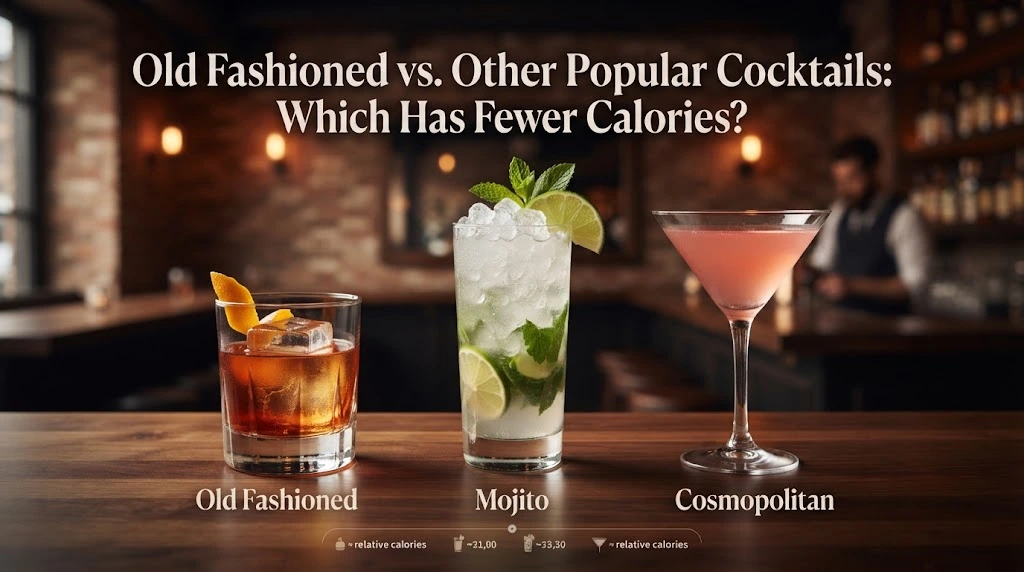
There is no universal ranking because recipes vary, but the Old Fashioned can be relatively straightforward compared with cocktails that contain multiple sweet ingredients.
A classic Old Fashioned contains whiskey, sugar, bitters, and water, with citrus used mainly as garnish.
Cocktails containing cream, sweet liqueurs, large amounts of syrup, or sugary mixers can have substantially more calories. However, a large Old Fashioned can still be calorie-dense because alcohol itself supplies calories.
The better comparison is not simply the cocktail’s name. Look at:
- Amount of alcohol
- Proof of the spirit
- Added sugar
- Sweet liqueurs
- Juice or soda
- Cream or coconut ingredients
- Serving size
For example, replacing a large 3-ounce Old Fashioned with a smaller 1½-ounce version can make a bigger difference than switching from bourbon to rye.
This is also why “skinny” cocktail labels can be misleading. A drink can have little sugar but still contain substantial calories from alcohol.
If you want a useful comparison, compare drinks based on actual ingredients and serving sizes, not marketing names.
Frequently Asked Questions About Old Fashioned Calories
How many calories are in an Old Fashioned cocktail?
A typical Old Fashioned contains around 150 to 200 calories, although the exact amount depends on the whiskey pour, alcohol proof, sugar or syrup, and recipe. Published recipes range from about 145 to 192 calories.
Is an Old Fashioned lower in calories than a Manhattan?
It depends on the recipes and serving sizes. A classic Old Fashioned uses whiskey, sugar, and bitters, while a Manhattan typically includes whiskey, sweet vermouth, and bitters. Compare the actual ingredients and amounts rather than assuming one drink is automatically lower in calories.
How many calories are in a 2-ounce bourbon Old Fashioned?
A 2-ounce pour of 80-proof bourbon contributes roughly 129 calories before the sugar and bitters are added. Depending on the sweetener, a finished 2-ounce Old Fashioned can reasonably fall in the 145–175 calorie range.
Does an Old Fashioned have a lot of sugar?
It can, but the amount varies. Traditional recipes may use only a teaspoon of sugar, while sweeter recipes use more syrup. Good Food’s version lists 7.2 grams of sugar per serving.
Can you make an Old Fashioned with fewer calories?
Yes. Use a measured 1½-ounce to 2-ounce whiskey pour, reduce the sugar, keep the bitters, and use an orange twist for aroma. A sugar-free variation can reduce the calorie count further, although it changes the cocktail’s flavor.
Does bourbon have more calories than rye whiskey?
Not necessarily. The calorie difference is generally more related to proof and serving size than whether the whiskey is bourbon or rye. Compare equal amounts at similar alcohol strengths for the fairest comparison.
Does removing the cherry make an Old Fashioned much lower in calories?
No. Removing one cherry may save a small amount, but it does not change the main calorie sources. Most of the calories come from the whiskey and added sugar, not the orange peel or garnish.
Conclusion
So, how many calories in an old fashioned? For most classic recipes, about 150 to 200 calories is a sensible working range, but the exact number can vary considerably.
The whiskey does most of the calorie-heavy lifting. Sugar or simple syrup adds additional calories, while bitters and an orange peel usually play a much smaller role.
If you want a lighter drink, you do not need to strip away everything that makes an Old Fashioned enjoyable. Measure the whiskey, choose a sensible pour, reduce the sweetener, and keep the bitters and citrus aroma that give the cocktail its character.
Most importantly, do not let one number create a false sense of precision. A cocktail made at home with a measured 1½-ounce pour is very different from a generously poured restaurant drink.
For practical calorie tracking, focus on the pour, proof, and sweetener first. Those three details will tell you far more than the garnish ever will.
And if you are enjoying an Old Fashioned occasionally, savor it. It is a drink built for slow sipping, good conversation, and appreciating a few well-balanced ingredients—not for rushing through a glass.